
A device list can look diverse while every task follows the same app flow, account state, locale, network profile, and starting state. The reverse can also happen: one physical device can be tested across several meaningful app, account, permission, or connectivity conditions. Those runs add environmental variation without adding hardware models.
For Mobile AI data collection and evaluation, device diversity and environment diversity answer related but different questions. Treating them as one count makes it harder to see what the evidence actually covers.
Define the two dimensions before counting
Device diversity describes which device profiles are represented. Depending on the claim, relevant details may include manufacturer and model, screen size and density, hardware features, and Android release or build. Keep hardware identity and software configuration visible as separate fields: two runs can share a model but use different platform versions, or use different models on the same platform version.
Environment diversity describes the conditions around a task attempt. These can include the app and app version, account or session state, permissions, locale, network conditions, and the app or system state at the start of the task. Some conditions interact with the device profile. A layout difference, for example, may reflect screen dimensions, display scaling, app version, or more than one factor.
Android’s testing tools make this distinction practical. Android Studio can run tests across selected device configurations, while Firebase Test Lab lets teams choose combinations such as devices, Android versions, locales, and screen orientations. That is a matrix of selected configurations—not a single device-count measure. Android Studio’s test guide describes the test matrix and configurable combinations.
Three datasets can have very different coverage
Imagine a form-submission task with one completion criterion: the requested record appears in the resulting app state.
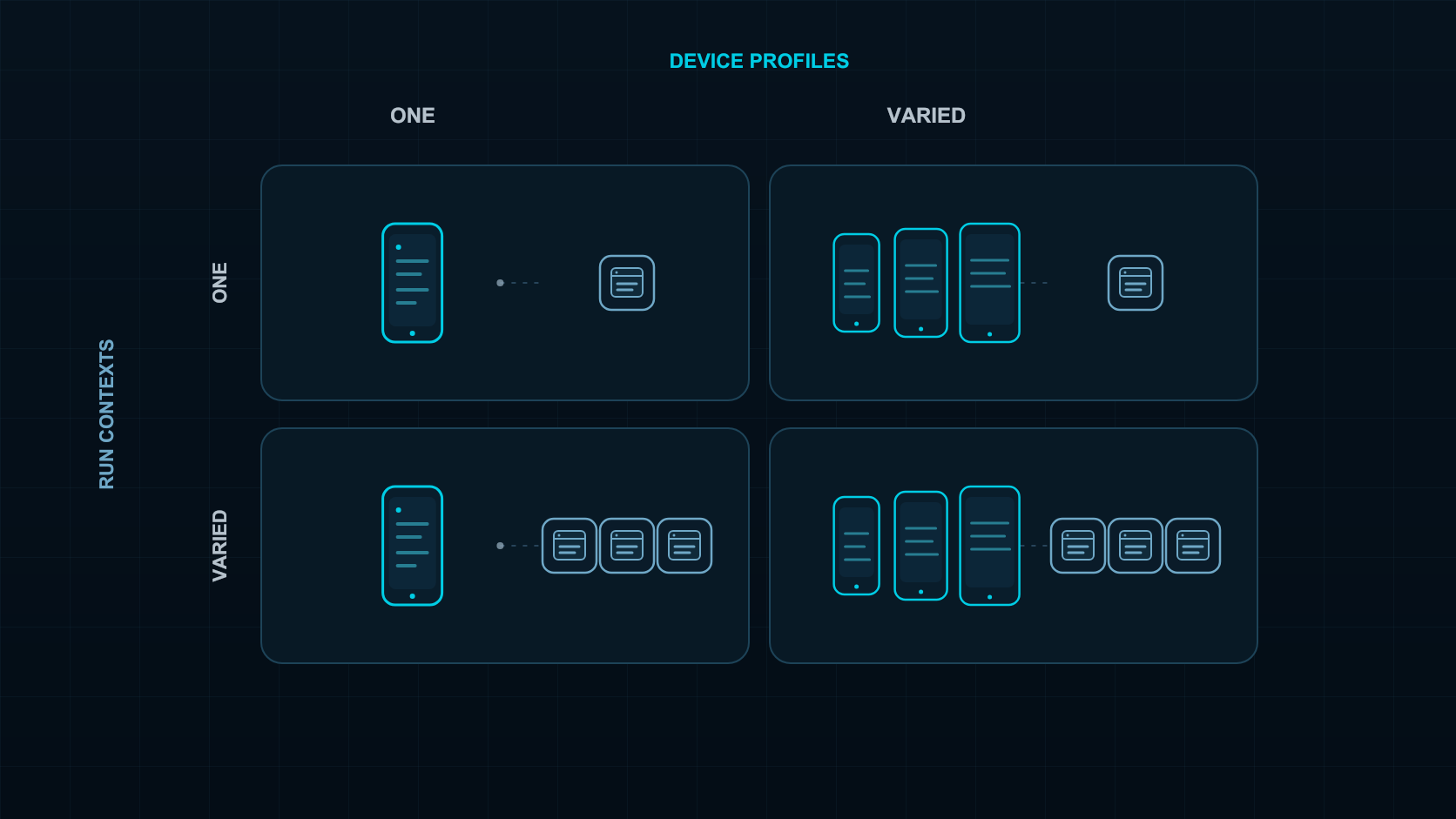
Several models, one run context. A team runs the same app build, account state, locale, network profile, and task on a small set of physical models. This adds device-profile coverage. It says little about behavior under other accounts, locales, app versions, or connectivity conditions.
One model, several run contexts. A team keeps one physical model and varies the app’s starting state, permission state, account state, or specified network condition. This can reveal context-sensitive behavior, but it does not establish coverage across hardware profiles.
Device and context both vary. A team tests selected model and OS combinations alongside chosen app, account, or network conditions. This can support a broader claim only if the combinations, attempt counts, completion check, and missing cells are reported. If many factors change together, the result may show that an outcome differed without showing which factor explains the difference.
A coverage matrix is clearer than one diversity score
Record each attempt against at least two views: its device profile and its run context. A compact matrix can show where the same context was exercised on multiple devices, where one device was exercised under multiple contexts, and where the study has not yet collected evidence. Keep the task definition and outcome criterion attached to each comparison.
Do not treat every possible combination as mandatory. A full cross-product of models, OS releases, apps, accounts, locales, and network conditions can grow quickly, and many combinations may not matter to the question. Select the dimensions that could change the task execution or interpretation, then explain the selection. Android’s documentation similarly frames multi-device testing as selected configurations; its examples include device profiles, API levels, locale, orientation, and screen size. See testing across multiple devices and build-managed device groups.
When the study needs to isolate a cause, vary one relevant factor at a time where practical and keep the others stable. When the intended question concerns realistic combinations, retain those combinations and describe them as such. In either case, distinguish a condition that was configured from one that was observed during execution.
Report what is covered—and what is not
For each dataset or evaluation, report the device and software profiles, the run-context conditions, how cases were selected, the number of attempts, and any missing or excluded combinations. Keep repeated attempts distinguishable from distinct device profiles: ten attempts on one model are not ten models, and ten models each run once do not establish repeatability.
A useful report can answer four separate questions:
- Which device profiles were included?
- Which app, account, system, locale, and connectivity conditions were exercised?
- Which factors were held stable or changed together?
- What evidence supports the completion claim for each attempt?
These details make the scope legible without implying that a convenience sample represents all Android devices or usage environments. They also help teams decide whether the next useful addition is another hardware profile, a new run condition, or a repeated attempt under a controlled setup.
More models are one kind of coverage
Device diversity and environment diversity overlap, but they are not interchangeable. More device models can expose hardware- or platform-dependent differences. More run contexts can expose changes tied to apps, accounts, permissions, locale, connectivity, or starting state. A study may need either dimension or both, depending on the claim it intends to support.
The practical question is not simply how many phones or scenarios were included. It is which dimensions changed, which were held constant, and what conclusion the resulting evidence can support.
Real Android infrastructure can provide access to physical device execution. The device selection, task setup, data capture, evaluation checks, and reporting needed for a particular study still have to be defined; device access alone does not establish broad device or environment coverage.