
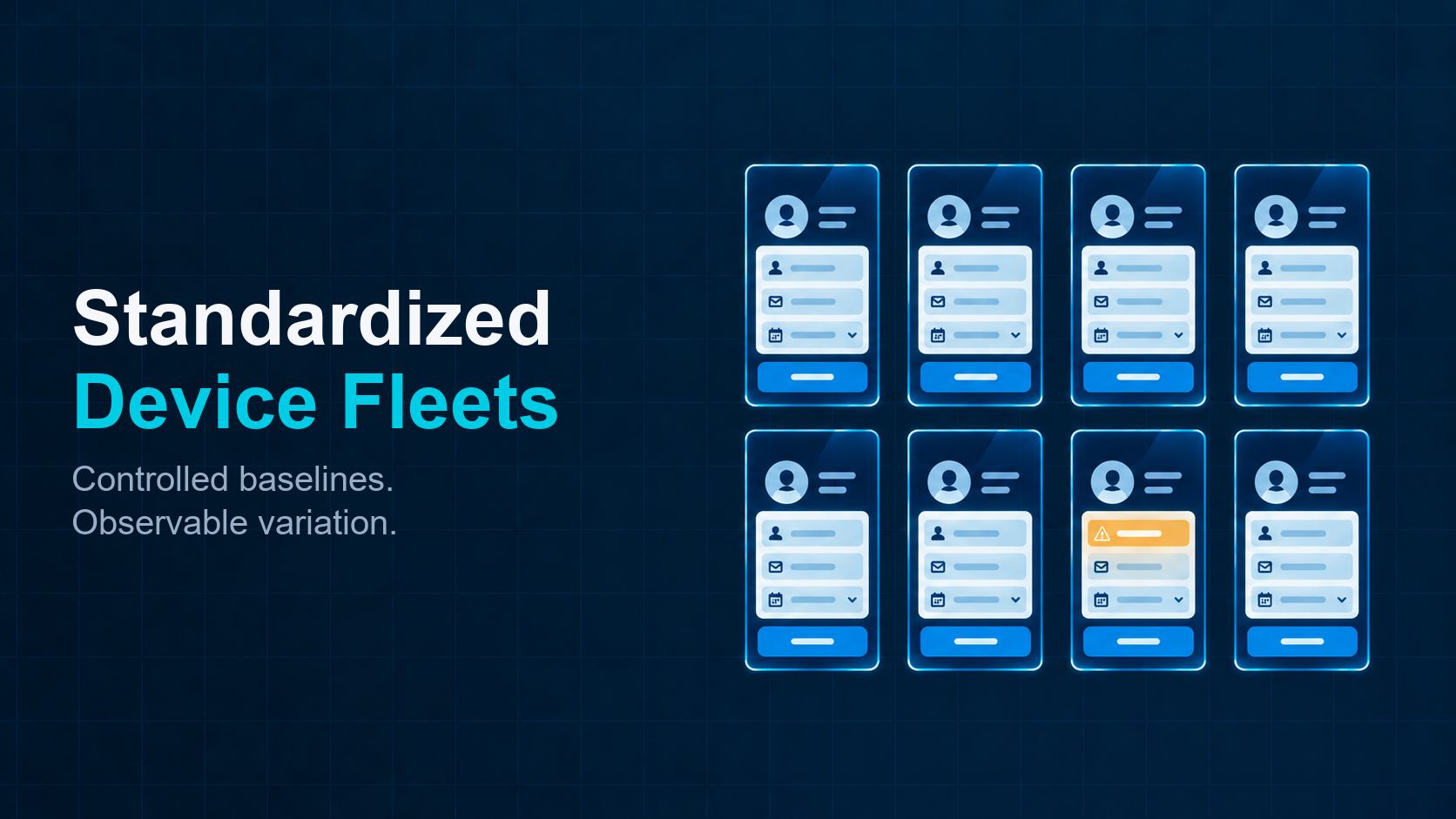
When a team collects interaction data across many Android devices, small configuration differences can become hard to distinguish from changes in agent behavior. A known hardware cohort narrows one part of that problem. Consistency still depends on the task, starting state, software, network conditions, capture process, and the metadata kept with each attempt.
The practical goal is not to make every device and run look the same. It is to define which conditions should remain stable for a particular collection question, observe the conditions that can still vary, and preserve enough context to interpret the resulting records.
Standardize the baseline that the question depends on
Consider a team comparing two versions of a mobile agent on a multi-step account workflow. If one batch runs on one device model and app build while the next batch mixes different screen sizes, OS versions, account states, and network profiles, a change in completion rate is difficult to attribute. A consistent device cohort removes some avoidable differences from that comparison.
Start by writing down the collection question and its completion criterion. Then identify the baseline conditions that could affect the observed behavior. Depending on the workflow, these may include:
- device model and hardware configuration;
- Android build and relevant system settings;
- target app build, permissions, and account or fixture state;
- locale, orientation, display settings, and input method;
- configured network profile and the connectivity actually observed;
- task version, agent or controller version, and outcome-check version;
- reset or preparation procedure and the evidence expected from each attempt.
Not every project needs every item fixed. A locale study should vary locale deliberately. A network-recovery test should vary the network condition. The point is to distinguish planned variation from accidental drift, rather than turning a checklist into a universal device specification.
Keep the cohort specification separate from each run
A cohort specification describes the baseline a team intends to use. A run record describes what a particular device actually did. These are related, but they are not interchangeable.
For each attempt, keep the cohort or configuration revision alongside observed device and software details, task and agent versions, starting-state checks, timestamps, outcome evidence, and any retry or exception. Record configured network conditions separately from observed connectivity. If a device has drifted from the intended baseline, retain that fact with the run instead of silently treating it as a normal member of the batch.
This distinction helps answer two different questions: “What conditions did we intend to compare?” and “What conditions were present for this attempt?” Without both, a label such as “standard fleet” can make a dataset look more uniform than its executions really were.
Make collection operations repeatable
Hardware similarity helps only when the collection process is also controlled. Use a versioned task definition, a checkable starting condition, a consistent capture policy, and the same outcome criterion across the runs being compared. Define how devices become eligible, how an incomplete attempt is handled, and when a device can be prepared for another task.
For example, a collection batch might use one named app build and account fixture, verify the expected screen before each attempt, capture the same evidence types, and assess completion with the same criterion. If the workflow must preserve state between steps, represent that sequence explicitly instead of resetting between every action. A repeatable process should preserve the state the question requires—not impose a clean reset when that would change the scenario.
Operational checks matter too. A shared hardware model does not guarantee that every unit has the same software patch, available storage, battery condition, thermal state, cable or radio behavior, or current connectivity. Track readiness and exceptions at the unit level. When preparation or recovery changes, version the procedure and keep the change visible in later results.
Treat drift as evidence, not noise to erase
Standardization reduces some sources of variation; it does not remove variation from physical execution. Asynchronous app work, service responses, timing, device condition, and network behavior can still differ between attempts. An unexpected observation may expose a genuine failure mode or a preparation problem.
Do not discard a run simply because it departed from the target baseline. Preserve the attempt and identify the deviation. Then decide whether it belongs in the controlled comparison, should be analyzed as a separate condition, or needs a rerun. Keep the original evidence and retry history so that a later success does not replace an earlier uncertain result.
This makes the collection process auditable. It also helps separate a change in agent behavior from a change in the device cohort, test fixture, or operating procedure.
A consistent cohort is not a compatibility matrix
A standardized cohort is useful when the question calls for repeated observations under a known baseline. It can support regression comparisons, controlled data collection, and investigation of changes over time. It cannot establish how the same workflow behaves across the broader Android device landscape.
Google’s Firebase Test Lab describes test matrices using selected device models, Android versions, screen orientations, and locales. That is a useful reminder that “coverage” is a set of explicit configurations, while a standardized cohort serves a different purpose: keeping a selected baseline stable enough for comparison. A team may need both, but the results should retain their cohort and configuration context rather than being collapsed into one unexplained score.
If a project needs both controlled collection and broad compatibility evidence, keep the workstreams distinguishable. Use the standardized cohort for the baseline question; add selected device and configuration variants for the coverage question. The second set should be chosen because it tests a relevant condition, not merely to make the inventory larger.
This is a different question from choosing which forms of variation matter in a dataset, as discussed in What Kind of Diversity Actually Matters in Mobile AI Data?. It also complements Repeatability vs. Reality in Mobile AI Data Collection, which examines how controlled runs and physical execution context support different claims.

Where a standard physical-device cohort fits
ARMARRAY S32 is a standard 32-node physical Android configuration. A defined hardware cohort can provide a consistent physical-device base for recurring collection or evaluation work. The customer’s task definitions, app and account fixtures, reset policy, capture process, and outcome criteria still determine how comparable the resulting runs are.
The right claim is bounded: standardization can reduce avoidable differences and make operational procedures easier to apply across a cohort. It does not promise identical device behavior, supply every Android model needed for compatibility testing, or make a dataset representative by itself.
Make consistency an explicit property of the dataset
Before a collection batch begins, name the question, the cohort revision, the conditions to hold stable, the conditions to vary, and the evidence needed to judge each attempt. During collection, preserve both intended configuration and observed execution context. When the baseline changes, give the new cohort or procedure a new revision and avoid silently combining it with earlier results.
That is how a standardized fleet becomes useful for data collection: not because all variation disappears, but because the relevant variation becomes easier to control, see, and explain.