

Mobile AI systems can be trained, tested, and evaluated across different execution environments.
Each environment exposes different evidence about the interaction being observed.
The important question is not which source is universally best. It is which environment provides the evidence needed for the task.
Different Sources Provide Different Evidence
Synthetic data, emulators, and real devices represent different ways of observing Mobile AI interactions. The same workflow can reveal different information depending on the environment where it is executed.
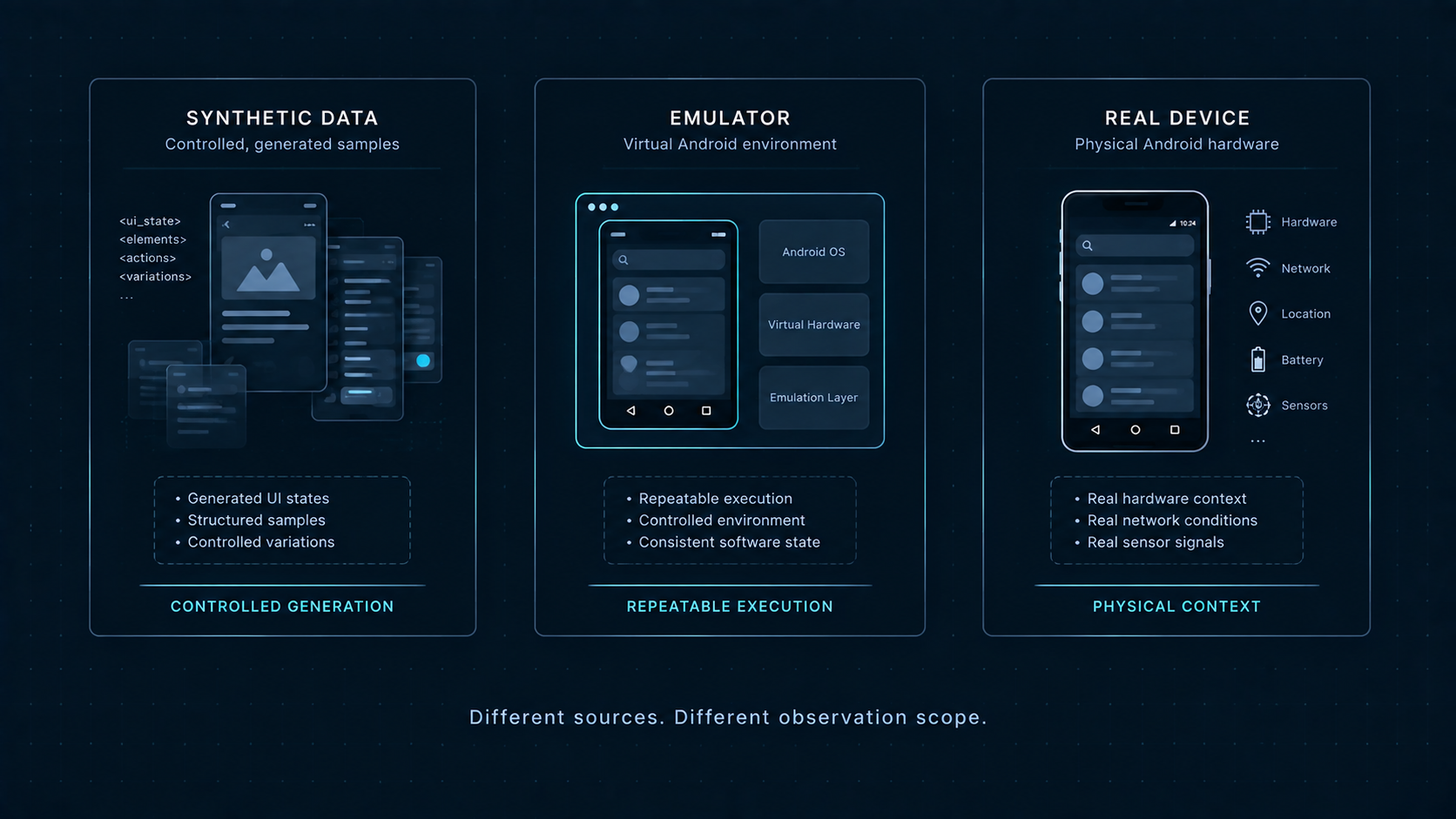
Synthetic Data: Controlled Possibilities
Synthetic data can represent generated interface states, structured samples, and controlled variations. It is useful when the objective is to explore possible states and organize interaction patterns.
Emulators: Repeatable Software Execution
Emulators provide a virtual Android environment where software execution can be reproduced under controlled conditions. They help isolate software behavior and compare repeatable runs.
Real Devices: Physical Execution Context
Real devices expose physical execution conditions, including hardware behavior, network conditions, sensors, and other characteristics of a physical Android environment.
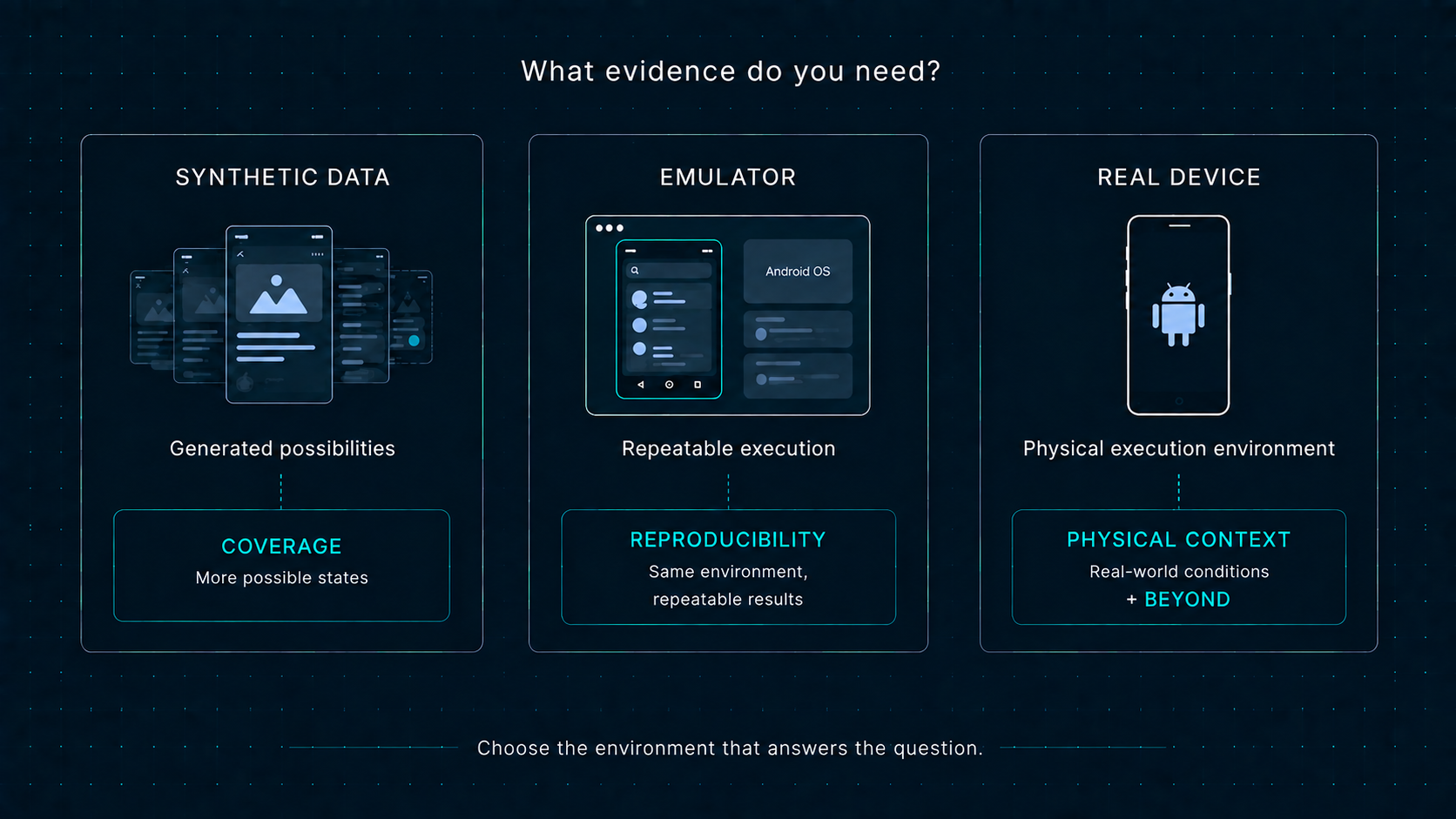
Different Questions Require Different Environments
Different evaluation questions require different evidence. Coverage, reproducibility, and physical context are separate dimensions that may require different environments.
A Practical Mobile AI Data Pipeline
A practical pipeline can combine environments according to the evidence required at each stage: generating possibilities, validating execution, and observing physical interaction context.
The Smallest Environment That Answers the Question
The most useful environment is the one that provides enough evidence for the question being asked. Selecting the appropriate execution context helps keep data collection focused and interpretable.
Real Android Infrastructure for Mobile AI
Real Android infrastructure provides physical execution environments for Mobile AI testing, evaluation, automation, and custom agent workflows.