
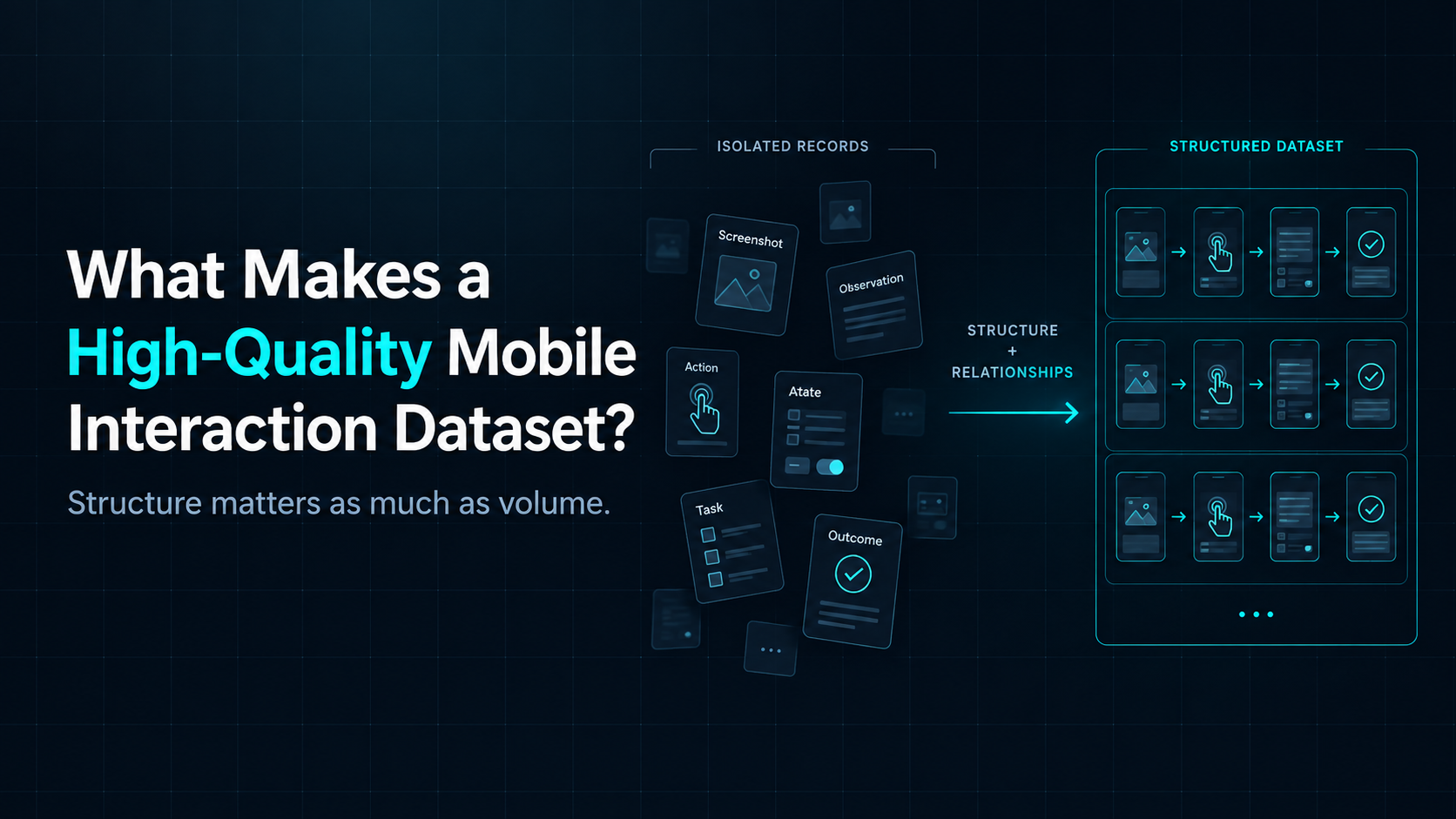
Collecting more screenshots, actions, and task runs increases the size of a Mobile AI dataset.
It does not automatically increase its quality.
A large collection of interaction records can still be difficult to understand, compare, or use if the relationships between those records are unclear.
Volume and quality are different properties.
A high-quality mobile interaction dataset is not defined by how much data it contains, but by how well the data preserves the structure, context, and meaning of the interactions it represents.
This shifts the question from:
How much data did we collect?
to:
How useful is the interaction information we preserved?
Quality Starts with Relationships
A dataset may contain screenshots, actions, task descriptions, and outcomes.
But the presence of those records alone does not tell us how they belong together.
Consider these records:
Observation
Action
Outcome
Each may be valid data.
But if their relationships are missing, we may not know whether the action followed that observation or whether the outcome resulted from that action.
Now preserve the relationship:
The records have not necessarily increased in number.
What changed is their structure.
Across a longer task, the relationship may look like:
The interaction becomes easier to reconstruct because the records preserve more than their individual contents.
They preserve how the execution unfolded.
Dataset quality begins with preserving relationships between records.
Structure: Can the Interaction Be Reconstructed?
Structure gives individual records a place inside an interaction.
A structured dataset should make it possible to understand how the pieces belong together.
At a high level, we may want to know:
Where did the task begin?
In what order did observations appear?
Which actions connected different states?
Which outcome belonged to which interaction?
This does not require every dataset to use the same schema.
Different Mobile AI systems may represent interactions differently.
The important point is that the structure should preserve enough relationship information for the interaction to be understood.
Good structure turns records into an interaction history.
Context: Do the Records Have Enough Meaning?
Structure tells us how records relate.
Context helps us understand what those records mean.
Consider an action:
Tap
By itself, the action tells us very little.
Now place it inside an interaction:
The action becomes easier to interpret because we know something about the task, the observed state, and what followed.
Context may include information about the task, execution environment, or other conditions relevant to interpreting the interaction.
The exact context required depends on the use case.
The goal is not to collect every possible piece of metadata.
The goal is to preserve enough context to make the interaction meaningful.
Without context, even accurately recorded events can be difficult to interpret.
Consistency: Can Different Runs Be Compared?
A useful dataset often contains many task runs.
Those runs do not need to be identical.
But equivalent information should be represented in a predictable way.
Imagine one run preserves observations, actions, and outcomes.
Another preserves observations and outcomes but omits the actions between them.
A third records similar information using a completely different structure.
Each run may still contain useful information.
Together, however, they become harder to compare and analyze consistently.
Consistency does not mean every interaction must be identical.
It means equivalent information should be represented in a predictable way.
That predictability makes it easier to compare interactions across tasks and runs without repeatedly reconstructing what each record means.
Traceability: Can We Follow the Interaction Backward?
Interaction data becomes more useful when an outcome can be connected back to the execution that produced it.
Suppose a task ends in a particular result.
Can we trace that result back through the interaction?
If those relationships are preserved, we can move through the interaction history and understand how the execution developed.
Traceability does not require turning every dataset into an audit system.
In this context, it simply means that important records retain enough relationship information to connect an outcome with the task and interaction that produced it.
A useful dataset should make it possible to trace an outcome back through the interaction that produced it.
Usability: Can the Dataset Be Used Without Reconstructing It by Hand?
A dataset can contain valuable information and still be difficult to use.
If every analysis requires someone to manually determine:
which screenshot belongs to which action,
which records belong to the same task run,
what order the records occurred in,
or how different runs represent equivalent information,
then much of the meaning exists outside the dataset itself.
It exists in the knowledge of the person who collected it.
That creates friction for training, analysis, and evaluation workflows.
A dataset becomes more useful when its meaning is carried by the data structure, not by the person who collected it.
This does not mean every downstream system needs the same representation.
It means the dataset should preserve enough structure and context that its meaning does not need to be rebuilt manually each time it is used.
Five Dimensions of Dataset Quality
These ideas can be summarized as five complementary dimensions:
- Structure
- how records relate to one another.
- Context
- what gives those records meaning.
- Consistency
- whether equivalent information is represented predictably.
- Traceability
- whether the interaction can be followed through its history.
- Usability
- whether the dataset can be used without repeatedly reconstructing its meaning.
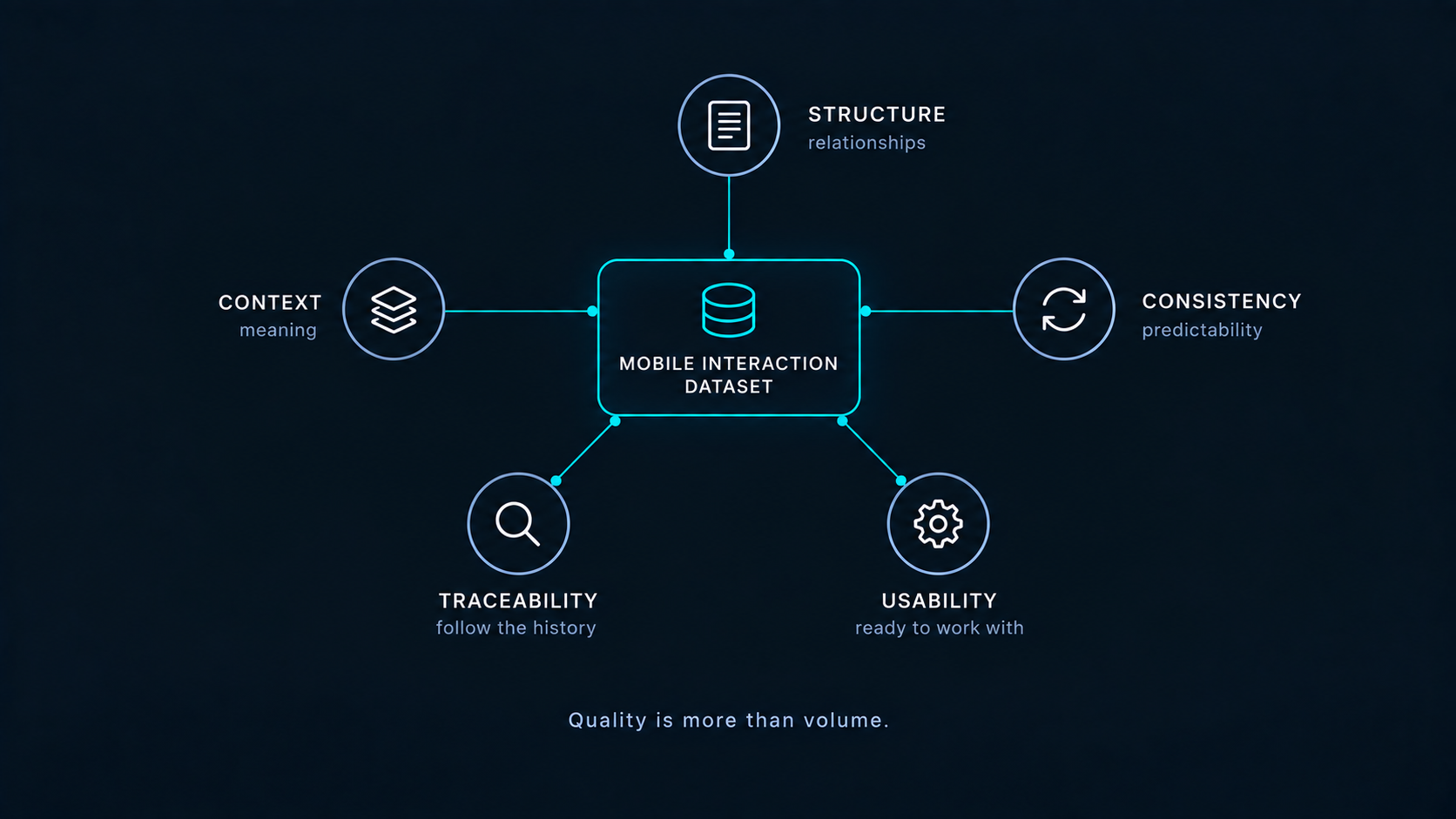
These dimensions are not sequential steps.
A dataset does not move from Structure to Context to Consistency in a fixed order.
They are different properties of the same interaction dataset.
Their importance may also vary depending on whether the data is being used for training, analysis, debugging, or evaluation.
The broader point is that dataset quality cannot be reduced to record count alone.
Quality Is a System Property
It is possible for the individual records inside a dataset to be valid while the dataset as a whole remains difficult to use.
A screenshot may accurately preserve a visible state.
An action record may accurately preserve what happened.
An outcome may accurately describe the end of a task.
But if those records cannot be reliably connected, much of their interaction meaning is lost.
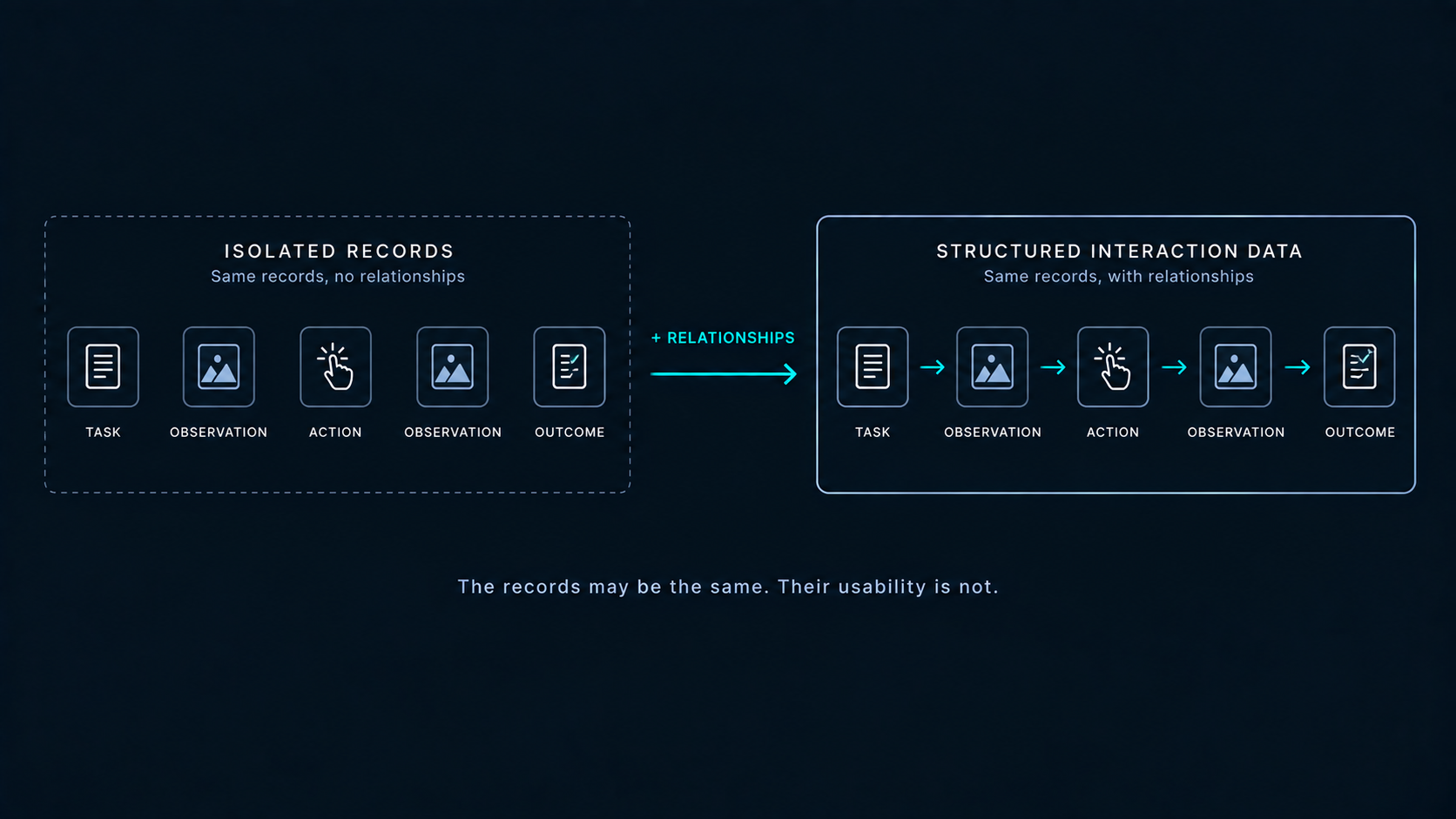
The records may be the same.
Their usability is not.
This is why dataset quality is partly a system property.
It emerges not only from the quality of individual records, but also from how those records are organized, related, and interpreted together.
Real Devices Do Not Automatically Create High-Quality Data
Physical Android devices can add real execution context to Mobile AI workflows.
They can expose tasks to real Android behavior, application behavior, device state, network conditions, and other properties of physical execution.
But real execution does not automatically produce structured data.
A large number of real-device task runs can still be difficult to use if observations, actions, states, and outcomes are not connected consistently.
Real Android provides an execution environment.
Dataset quality still depends on how interaction information is preserved.
ARMARRAY is building Real Android infrastructure for Mobile AI Data Collection & Evaluation, providing the physical execution layer where these workflows can run.
The infrastructure can provide the environment in which interaction data is generated.
The quality of the resulting dataset still depends on how that interaction is structured, contextualized, connected, and made usable.
Next: Synthetic Data, Emulators, or Real Devices?
Once we define what makes interaction data useful, another question becomes easier to ask:
Where should that data come from?
Synthetic environments, emulators, and physical devices can each contribute different kinds of execution context.
The useful question is not simply which source is best.
It is:
What are you trying to observe, reproduce, or evaluate?
In the next article, we’ll compare synthetic data, emulators, and real devices as sources of Mobile AI interaction data.