
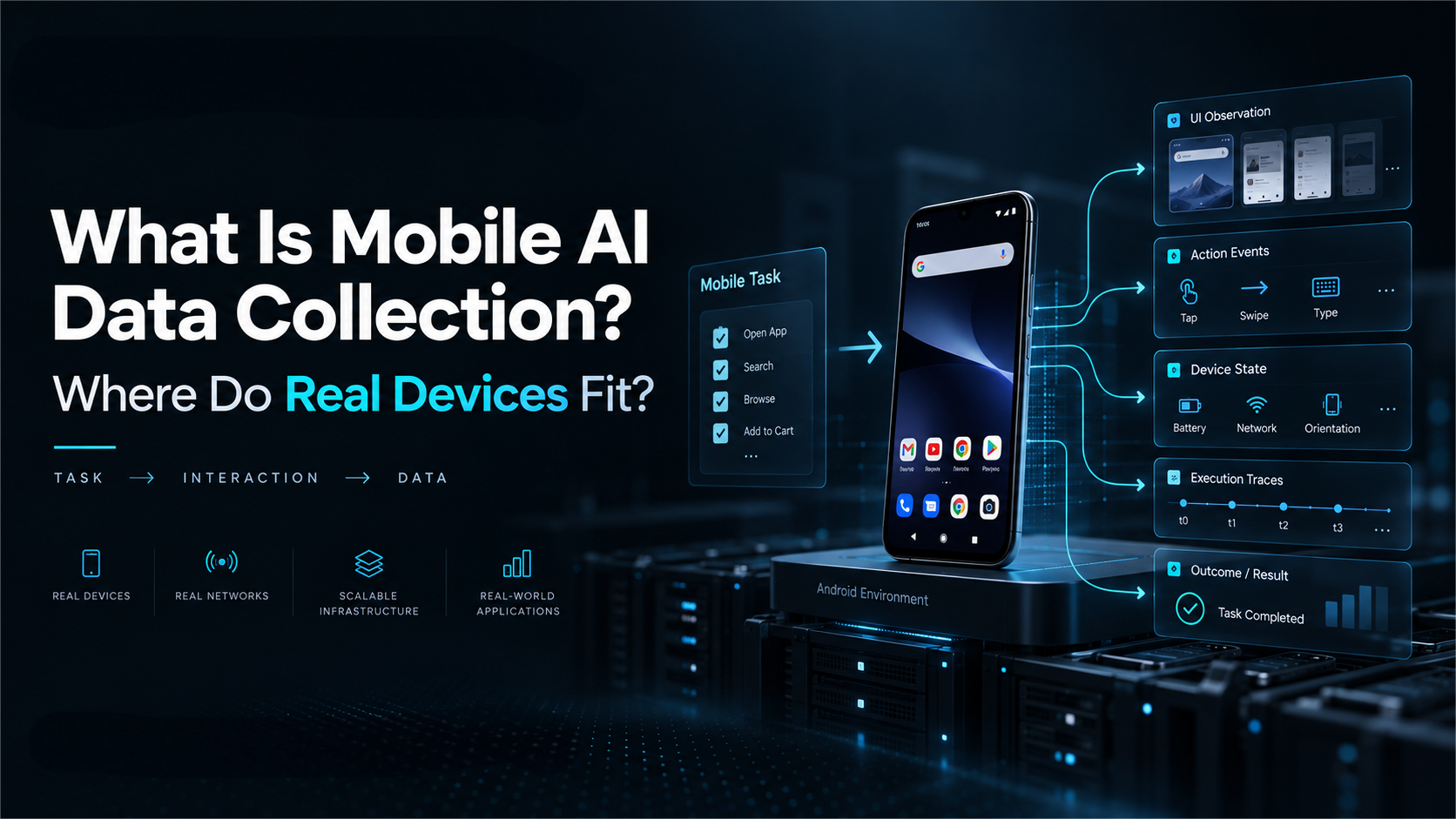
Mobile AI Is More Than Input → Model → Output
For many AI systems, it is natural to think in terms of a simple flow:
Input → Model → Output
Mobile AI agents operate differently.
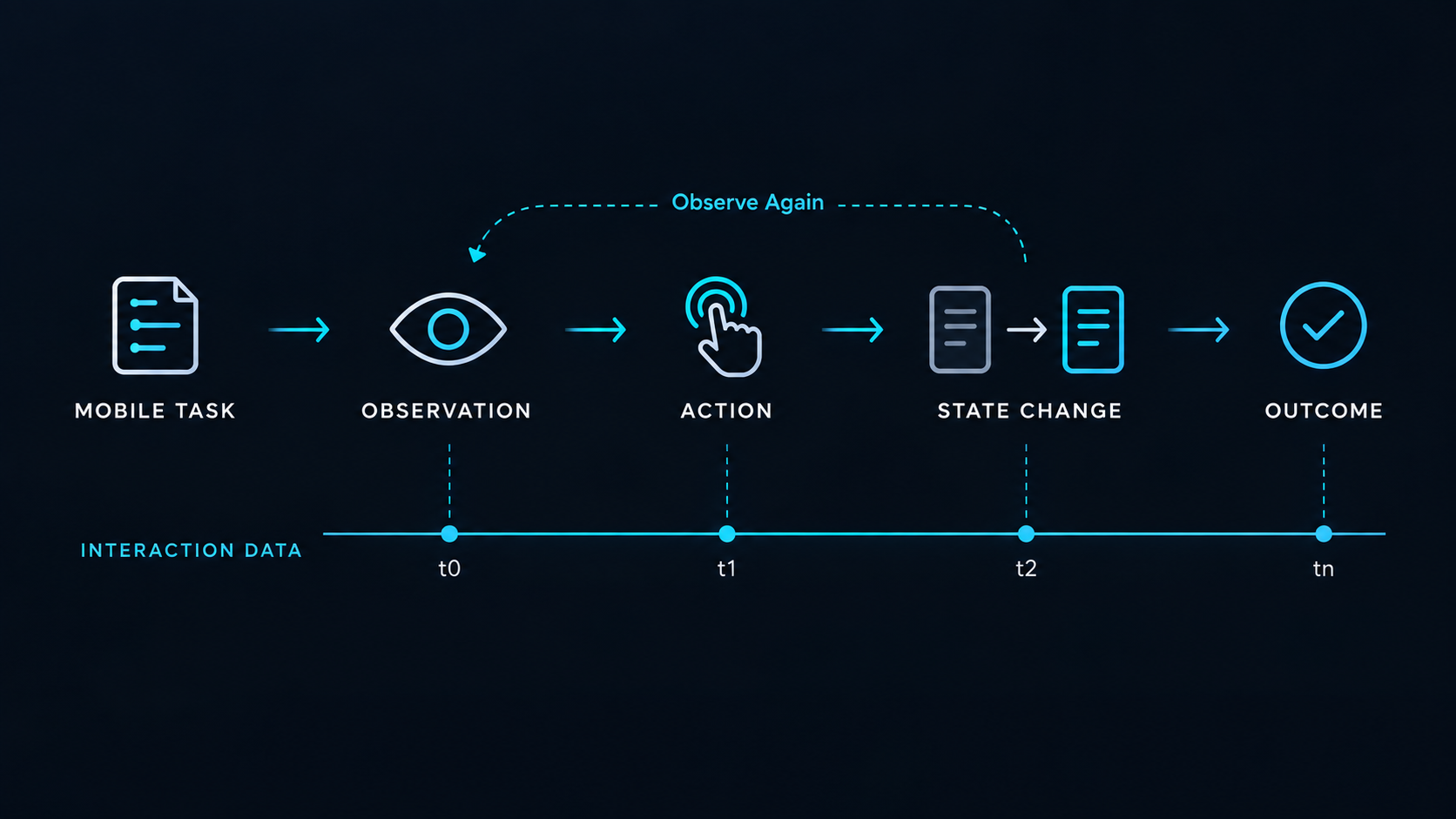
An agent may receive a task, observe an application interface, decide what to do next, perform an action, observe how the environment changes, and continue until the task reaches an outcome.
A simplified interaction looks like this:
Mobile Task → Observation → Action → State Change → Outcome
The important point is that useful information is produced throughout this process.
The final result matters, but it is only one part of the evidence generated during execution.
A Mobile Task Is a Data-Producing Process
Consider a simple mobile task.
An agent first observes the current environment. It may receive visual information from the screen, structured interface information, or other available state.
It then performs an action.
The application or device responds. The state changes.
The agent observes again and decides what to do next.
This creates a repeated interaction pattern:
Observe → Act → State Changes → Observe Again
Each step can generate useful evidence about how the agent understood and interacted with the environment.
That is why Mobile AI data collection is not simply a matter of capturing screenshots or recording whether a task eventually succeeded.
It is about capturing meaningful evidence from the execution process.
Why Collect This Interaction Data?
Different Mobile AI workflows need data for different reasons.
During development, interaction data helps engineers understand what the agent observed and how it responded.
During training and improvement, recorded interactions can provide examples of how tasks unfold across multiple steps.
During evaluation, execution evidence helps determine not only whether an agent reached an expected outcome, but also what happened along the way.
The exact data required depends on the task.
That question deserves its own discussion—and it is where this series goes next.
Does Mobile AI Data Have to Come From Real Devices?
No.
This distinction matters.
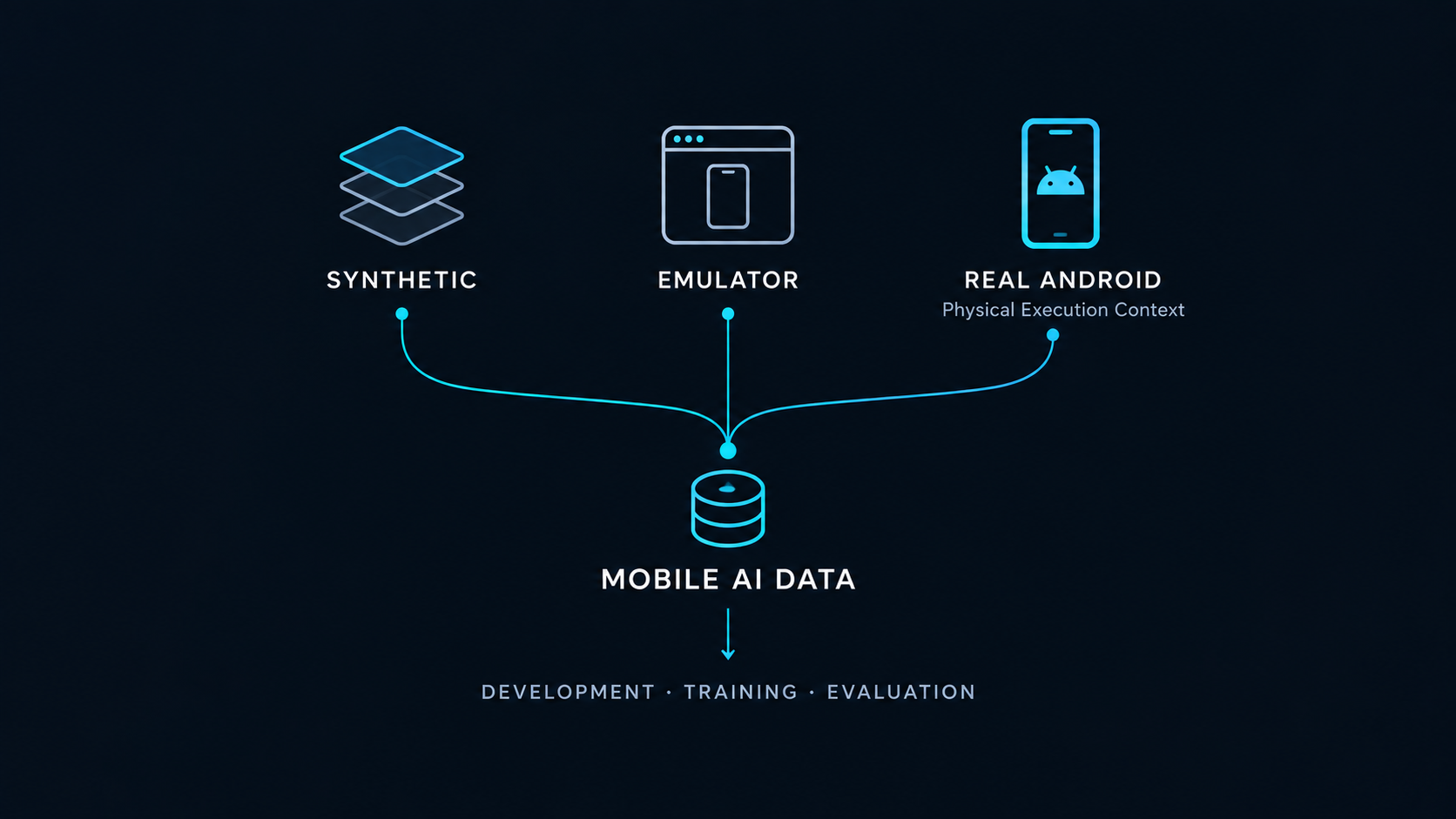
Useful Mobile AI data can come from different execution environments.
Synthetic environments can be useful when generating controlled or scalable examples.
Emulators can provide reproducible software environments for development, experimentation, and testing.
Real Android devices provide another source of execution data.
These environments should not be treated as mutually exclusive choices.
The better question is:
What are you trying to observe, reproduce, or evaluate?
Different stages of Mobile AI development may require different levels of control, variation, and real-world context.
Where Do Real Android Devices Fit?
Real devices become relevant when the physical execution environment itself matters to the data being collected.
Running an AI-driven workflow on physical Android introduces context that may include actual device state, application behavior, system behavior, network conditions, timing, and physical interaction characteristics.
This does not mean that real-device data is automatically better data.
It means that it answers a different class of questions.
If the objective is rapid iteration under tightly controlled conditions, another environment may be more appropriate.
If the objective is to observe how an AI workflow behaves when it reaches a physical Android environment, real devices can add an additional layer of execution evidence.
In that sense:
Real Android adds physical execution context to the Mobile AI data collection process.
This is where real devices fit—not as a replacement for every other environment, but as one layer in a broader Mobile AI data strategy.
From Devices to Data Infrastructure
Once real-device execution becomes part of a Mobile AI workflow, another engineering question eventually appears.
Collecting evidence from one device is relatively simple.
Doing it repeatedly, programmatically, and across many physical Android environments is a different problem.
Devices need to become accessible as infrastructure rather than isolated pieces of hardware.
That transition—from individual execution environments to programmable data collection infrastructure—is where our work at ARMARRAY is focused.
ARMARRAY is building Real Android infrastructure for Mobile AI Data Collection & Evaluation.
The goal is not to replace synthetic environments or emulators.
It is to make physical Android execution available as a practical infrastructure layer when Mobile AI teams need real-device evidence.
Next: What Data Does a Mobile AI System Actually Need?
We have established the basic idea:
Mobile interaction is a data-producing process.
But “Mobile AI data” is still a broad term.
What should actually be captured?
Screenshots? UI state? Actions? Application state? Device state? Task results?
That is the subject of the next article:
What Data Does a Mobile AI System Actually Need?