
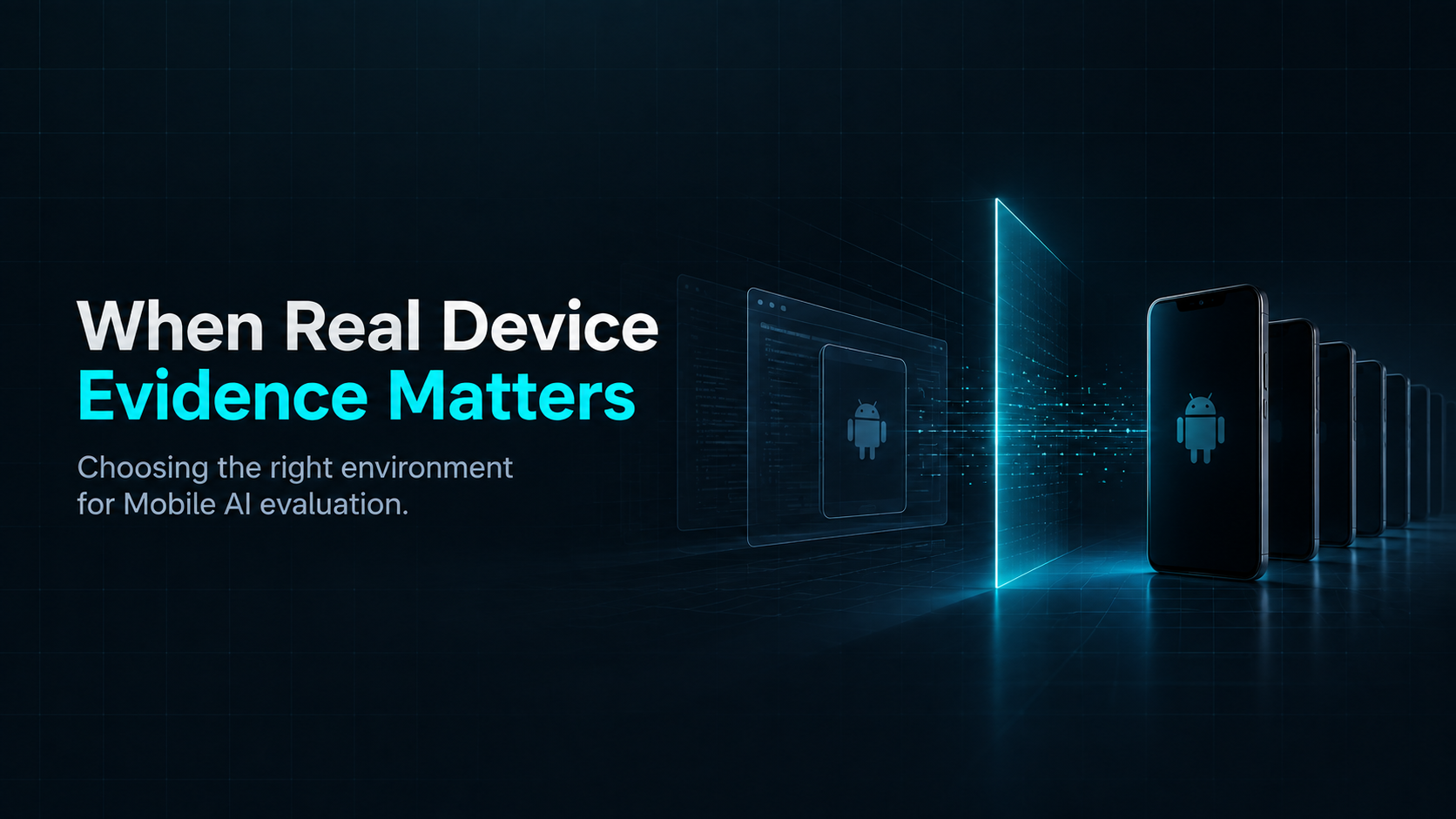
Mobile AI systems do not always need physical devices.
Many tasks can be developed, tested, and repeated effectively in emulated environments. For some questions, an emulator provides exactly the evidence required.
But other questions depend on what happens when software interacts with a physical Android environment.
The boundary is not simply between “virtual” and “real.”
It is between questions that can be answered through a software representation and questions that depend on physical execution.
That distinction helps determine when an emulator is enough—and when a real device adds information that the emulator was never intended to provide.
Emulators Are a Powerful Development Environment
Emulators solve an important engineering problem: they make Android environments reproducible and programmable.
A team can create known configurations, reset environments, repeat workflows, inspect application behavior, and reproduce software conditions without managing a large physical device fleet.
For many Mobile AI workflows, this is exactly what is needed.
If the question is primarily about application logic, interface behavior, navigation structure, or repeatable interaction under controlled conditions, an emulator may provide sufficient evidence.
Examples include:
- validating whether an agent can navigate a known interface
- testing interaction logic against repeatable application states
- reproducing specific software configurations
- running controlled regression workflows
- exploring large numbers of generated or predefined states
In these cases, adding physical devices does not automatically make the experiment more useful.
The environment should match the question.
The Boundary Appears When Execution Context Matters
A software environment can represent many conditions.
But representing a condition and observing physical execution under that condition are not always the same thing.
Consider a Mobile AI agent interacting with an Android application.
The visible screen may look familiar.
The action may also be familiar:
Tap.
Swipe.
Type.
Launch an application.
Return to the previous screen.
From the agent’s perspective, these actions can often be expressed in the same way across environments.
What changes is the execution context surrounding them.
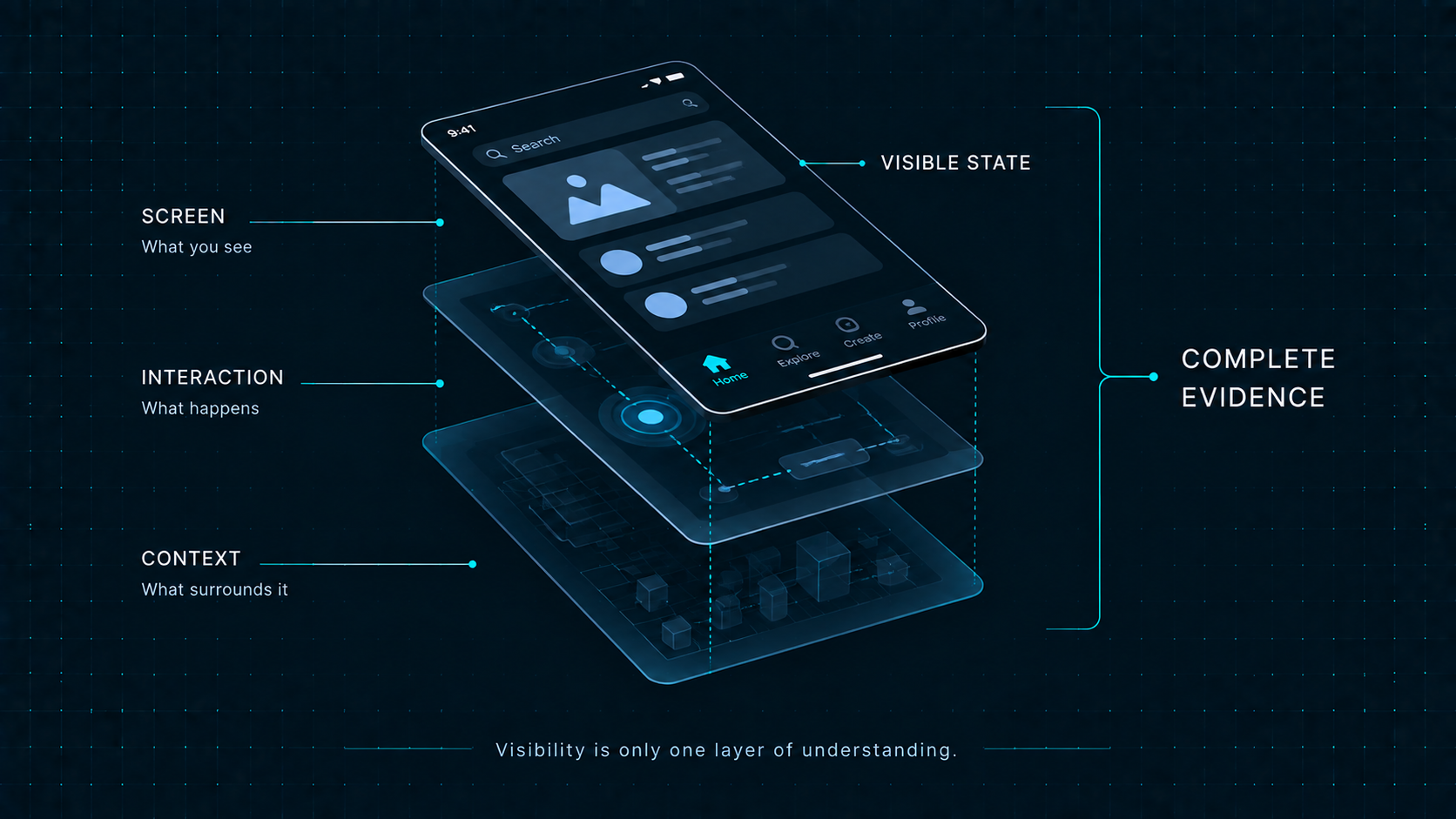
On a physical device, the interaction is occurring inside an actual Android execution environment with real device behavior and the surrounding runtime context.
This distinction matters only when that context affects the question being asked.
That is the boundary.
The Same Visible State Does Not Always Mean the Same Evidence
A screenshot tells us what was visible at one moment.
It does not tell us everything about the environment that produced that state.
Two environments may present a similar interface while differing in the execution conditions surrounding the interaction.
For some experiments, those differences are irrelevant.
For others, they are exactly what needs to be observed.
This is why visual similarity should not be confused with evidence equivalence.
The question is not:
“Does the emulator look like the device?”
The more useful question is:
“Does this environment preserve the conditions that matter for this experiment?”
When an Emulator Is Enough
An emulator is enough when the evidence required by the task remains inside the software-defined environment.
Suppose a team wants to test whether an agent can:
open an application,
locate a known control,
enter text,
navigate through several screens,
and reach an expected UI state.
If the purpose is to validate the agent’s interaction logic under controlled and reproducible conditions, a physical device may add little to the answer.
The experiment is fundamentally asking:
Can the agent perform this software interaction?
A reproducible software environment can answer that question well.
This is an important principle for Mobile AI infrastructure:
Use the smallest environment that can produce the evidence you need.
Where Real Devices Begin to Add Value
Real devices become useful when physical execution itself contributes to the evidence.
This does not mean that every real-device run is automatically more valuable.
It means the scope of observation has changed.
Instead of asking only how an agent behaves inside a represented Android environment, the experiment may need to observe how the workflow behaves when executed on physical Android hardware.
The relevant evidence can now include behavior that emerges from the execution environment rather than only from the visible interface.
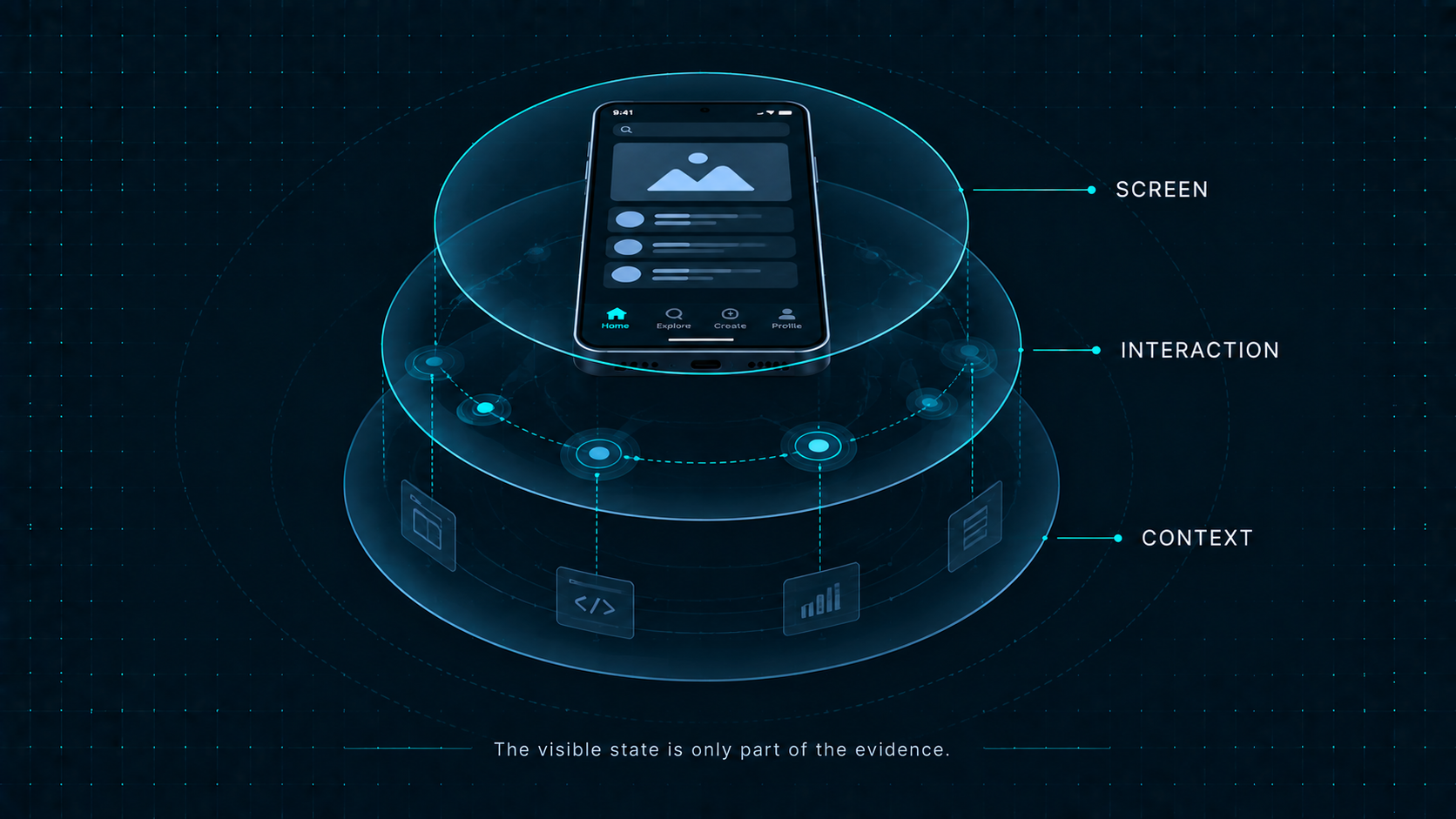
At that point, the physical device is not simply another place to run the same test.
It becomes part of what is being observed.
Think in Terms of Evidence Boundaries
A useful way to choose an environment is to define the boundary of the evidence first.
If the evidence boundary ends at software behavior, an emulator may be enough.
If the evidence boundary includes physical execution behavior, a real device may be necessary.
This reframes infrastructure selection around the experiment rather than around the technology.
Instead of asking:
Emulator or real device?
Ask:
What must this experiment observe?
Then choose the environment capable of exposing that evidence.
Development and Validation Do Not Need the Same Environment
The environment used to build a Mobile AI system does not have to be the environment used for every stage of validation.
A workflow can begin in a controlled environment.
Interaction logic can be developed and repeated there.
Large numbers of software-defined states can be explored without introducing unnecessary physical infrastructure.
Then, when the questions begin to depend on physical execution, selected workflows can move onto real Android devices.
This creates a practical progression:
Controlled Development → Repeatable Execution → Physical Validation
This is not a hierarchy of environments.
It is a change in what the experiment needs to observe.
Real Devices Should Answer a Specific Question
Adding physical devices without defining why they are needed creates infrastructure without additional understanding.
A real-device run should therefore have a reason.
For example:
Does the behavior remain consistent during physical execution?
Does the workflow produce the expected result outside the represented environment?
Does the surrounding execution context change what the system observes?
Can the interaction be reproduced on the actual device environment being evaluated?
These are questions about evidence.
Once the question depends on physical execution, real devices have a clear role.
Before that point, they may simply add operational complexity.
A Practical Mobile AI Workflow Can Use Both
Emulators and real devices do not need to compete for the same role.
A Mobile AI workflow can use each where its characteristics are useful.
Emulators can provide controlled, reproducible software execution.
Real devices can provide physical execution evidence when that evidence becomes relevant.
The transition between them should happen because the question changes—not because one environment is assumed to be universally preferable.
This leads to a simple infrastructure principle:
Use emulation where representation is sufficient.
Use physical devices where execution itself must be observed.
Real Android as an Execution Layer
As Mobile AI systems move from controlled development toward real-world validation, infrastructure requirements also change.
The problem is no longer only providing an Android environment.
It becomes providing physical Android execution in a form that can participate in an engineering workflow.
That means real devices need to become manageable infrastructure rather than isolated phones on a desk.
ARMARRAY is building Real Android infrastructure for Mobile AI agents, providing a physical execution layer for real-device workflows, data collection, testing, and evaluation.
The role of that layer is not to replace emulators.
It is to provide physical execution when the evidence required by the workflow extends beyond a software representation.
Next: Why Real-World Mobile Behavior Matters
Once physical execution becomes part of the evidence, another question appears:
What exactly can real-world mobile behavior add to a Mobile AI dataset?
In the next article, we’ll look at why execution behavior matters—and which parts of that behavior are actually useful to capture.